AdRoll ABM buys display and retargeting aimed at target accounts, and it used to be called RollWorks. Which alternative fits depends on the job you need done and the size of the team doing it.
- You are a first marketer, founder or lean team that runs your own Google, LinkedIn and Meta ads and wants to start without a sales call: Hero Marketer.
- You want a vendor to build and run paid media across many channels: Metadata.io.
- You run a sales led ABM program and need intent data on target accounts: 6sense or Demandbase.
- You need to know which channel earns credit for pipeline: HockeyStack or Dreamdata.
- You want display and retargeting aimed at target accounts: stay on AdRoll ABM.
We make Hero Marketer, so it is first on this list. Every entry says where the tool fits and where it does not.
What AdRoll ABM does well
AdRoll (opens in new tab) offers AdRoll ABM to B2B revenue and marketing teams, and its homepage labels the product “formerly RollWorks”. You create, manage and optimize campaigns from one dashboard, across display, native, video, connected TV, mobile, social and out of home.
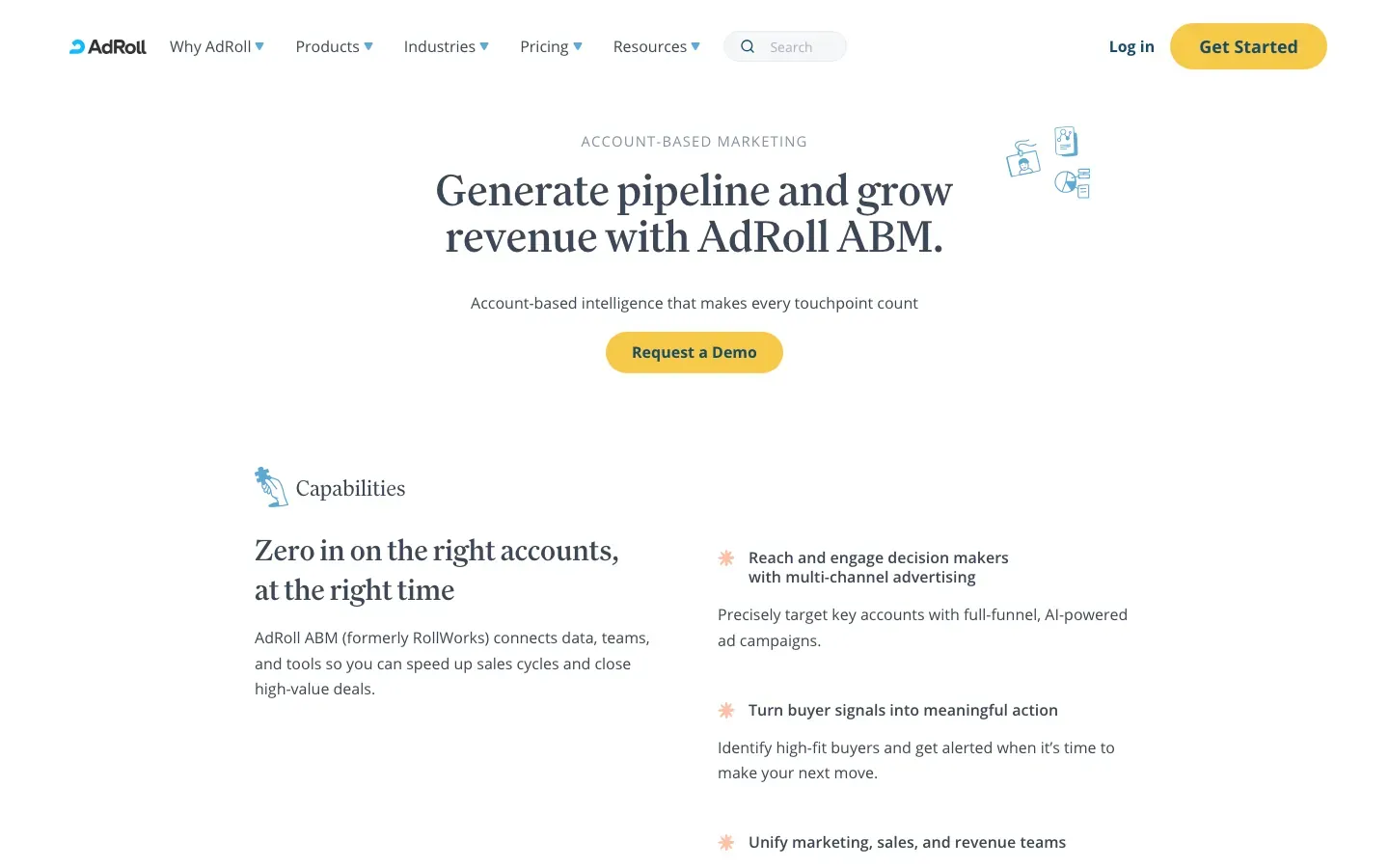
Starting is easy. According to its pricing page (opens in new tab), the Ads plan is self serve with no minimum spend, and media is priced per thousand impressions. The Account Based Retargeting package has no fee to start, and you pay only for media. Most ABM packages start with a demo request, and the managed Advanced package asks for a one year commitment.
That is a good offer for a team that wants programmatic reach for named accounts. The rest of this post is for the team whose weekly work is search, LinkedIn and Meta.
Why teams look for an AdRoll ABM alternative
The reasons repeat, and most are about fit, not quality.
It buys reach, and you still need campaigns. AdRoll ABM buys programmatic media for accounts and retargets them. A first marketer who needs Google search, LinkedIn and Meta campaigns built and fixed has the same work left over.
There is no number to plan with. The pricing page shows no dollar figures, and media priced per thousand impressions moves with demand. That is a hard budget to forecast when you own one ads number.
Packages and commitments vary. As the pricing page above says, most ABM packages start with a demo request, and the Advanced package needs a one year commitment. Some teams want to start today and stop whenever they like.
You want to make the calls yourself. A lean team often wants to learn the platforms while it decides, not hand the buying to a package.
You need a different job done. Some teams searching for AdRoll ABM alternatives want intent data, a vendor that runs many channels, or attribution. Those are different tools for different jobs, and this list covers them too.
AdRoll ABM alternatives compared
| Tool | Best for | What it does | How you buy | Where it falls short for a small team |
|---|---|---|---|---|
| Hero Marketer | Lean B2B SaaS teams that run their own ads | Builds campaigns, checks your accounts every morning and makes the changes you approve | Pay as you go: a day rate for each ad account it watches, plus AI work as you use it | Three platforms, and attribution through HubSpot only |
| Metadata.io | Enterprise paid media teams | Builds and runs campaigns on twelve channels | Pricing scoped per team on a demo | No public price, and built for a larger team |
| 6sense | Sales led ABM with intent data | Intent data, sales intelligence and advertising that syncs audiences and runs its own demand side platform | Custom quote or demo | A broad platform sold as a custom package to sales and marketing together |
| Demandbase | Account based go to market teams | Finds in market accounts and buying groups, then advertises to them across channels | Custom plan after a form | Built around account lists and sales alignment, not one marketer running search and social |
| HockeyStack | Attribution for B2B SaaS with about 100 people or more | GTM analytics and attribution | Custom plans on a demo, with startup pricing available | Measures the ads, does not run them, and its own guide points small teams away |
| Dreamdata | B2B attribution that starts on a free plan | Attribution across the customer journey | Free plan. Advanced plan on a demo | Measures the ads, does not run them |
| AdRoll ABM | Display and retargeting for target accounts | Programmatic ads across display, native, video and connected TV | Self serve pay as you go for ads. Most ABM packages start with a demo | Does not build Google search, LinkedIn or Meta campaigns |
1. Hero Marketer: best for lean B2B SaaS teams that run their own ads
Hero Marketer is an AI agent for B2B SaaS ads on Google, LinkedIn and Meta, where AdRoll ABM is a way to buy programmatic media. Give it your product and it builds campaigns, ad copy and images from it. Each morning it checks your ad accounts and makes the changes you approve. Connect HubSpot and it shows which channels and campaigns bring SQLs, deals and customers.
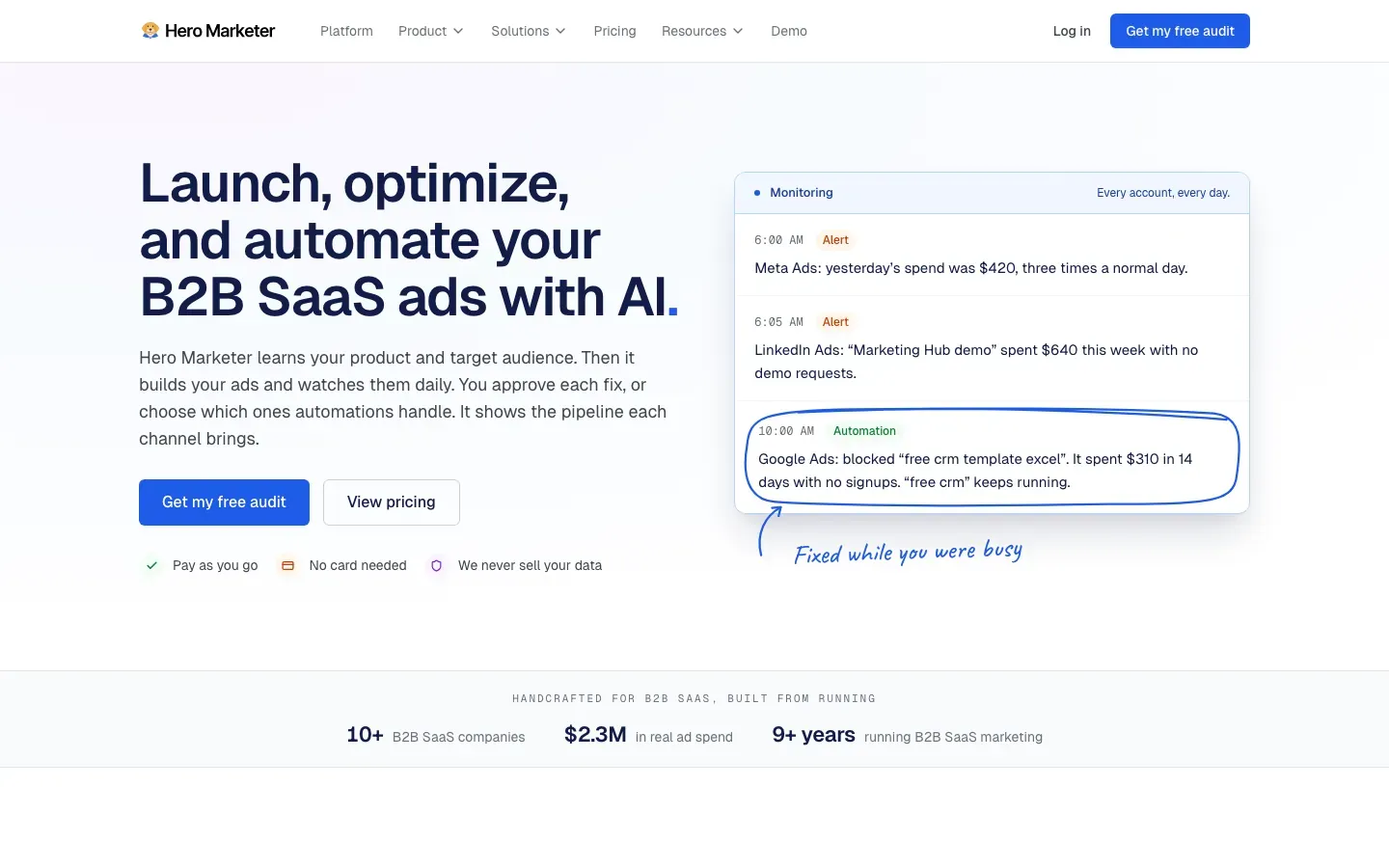
Hero Marketer is an AdRoll ABM alternative for small B2B SaaS teams: one marketer or founder directs it, and there is no sales call. You connect an ad account, get a free audit with no card needed, and decide from there.
Where it beats AdRoll ABM for a small team
The first difference is the job. AdRoll ABM buys media for accounts. Hero Marketer works inside the Google, LinkedIn and Meta accounts you already run, and your campaigns stay there.
The second is what happens after launch. Every account gets a look each morning, and you get an email only when something needs you. With daily Google Ads monitoring, a campaign that spends and brings no leads shows up within days, not when the month closes.
The third is where a campaign starts. The Google Ads campaign builder takes the product page you already have and gives you a campaign ready to launch, and LinkedIn and Meta campaigns begin the same way. AdRoll ABM starts from channels and accounts instead.
Pros
- It is built for B2B SaaS, so it judges your ads on lead quality and long sales cycles.
- You make the calls: changes wait for your approval, unless you switch on a rule that allows them.
- You can start without a call. The dashboards are free and teammates join free.
- Your campaigns stay in your own ad accounts, and unused credits are refundable within 90 days.
Cons
- It covers three platforms: Google, LinkedIn and Meta. For Microsoft Bing, Reddit or TikTok, you need another tool.
- Its attribution is lighter than a dedicated tool’s, because it connects to one CRM: HubSpot.
Where AdRoll ABM is the better pick
- Programmatic reach. AdRoll lists display, native, video, connected TV, mobile, social and out of home. Hero Marketer does not buy display or connected TV.
- Retargeting aimed at accounts. AdRoll ABM has an Account Based Retargeting package for the accounts you target. If your plan is to reach a named list again and again across the web, that is its home ground.
- A self serve media plan. Its Ads plan has no minimum spend, and you pay for media as you go. If display is the job, that is the simpler start.
How you pay
Hero Marketer charges $0.25 a day for each ad account it watches, plus AI work as you use it. See the pay as you go pricing for what a typical job costs.
2. Metadata.io: best for enterprise teams that want a vendor to run paid media
Metadata.io (opens in new tab) says on its homepage that you can build and run B2B campaigns in one product: audiences, landing pages and ads, run and optimized from one place. Your team sets goals, budgets and approvals.
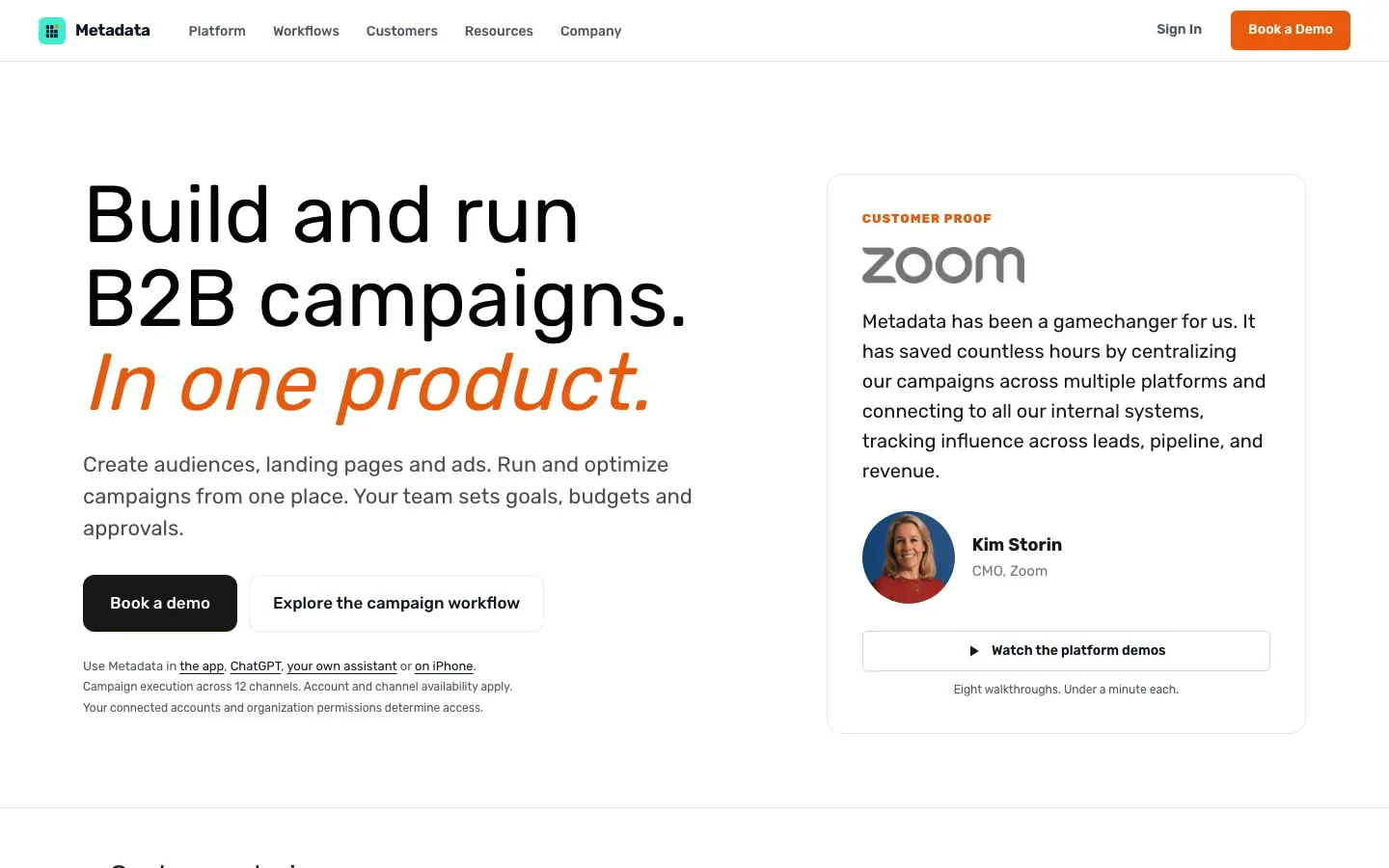
Where it beats AdRoll ABM: it builds and runs the campaigns, not only the media buy. Its platform page (opens in new tab) lists twelve channels, including Google, LinkedIn, Facebook, Instagram, display and connected TV. Agents write landing pages and ad creative and run experiments, then scale the winners and stop the losers.
Where it falls short for a small team: its pricing page (opens in new tab) lists no price. Pricing is scoped per team on a demo, and depends on your channels, the ad spend it manages and the work you hand over. It is also built for a larger team: its company page (opens in new tab) says enterprise B2B demand and revenue teams.
If you want to weigh the two models side by side, see Metadata.io compared with Hero Marketer.
3. 6sense: best for sales led ABM programs that need intent data
6sense (opens in new tab) calls itself a partner for agentic go to market. It sells intent data on who is researching, company and contact data, and sales intelligence that ranks accounts and suggests next actions.
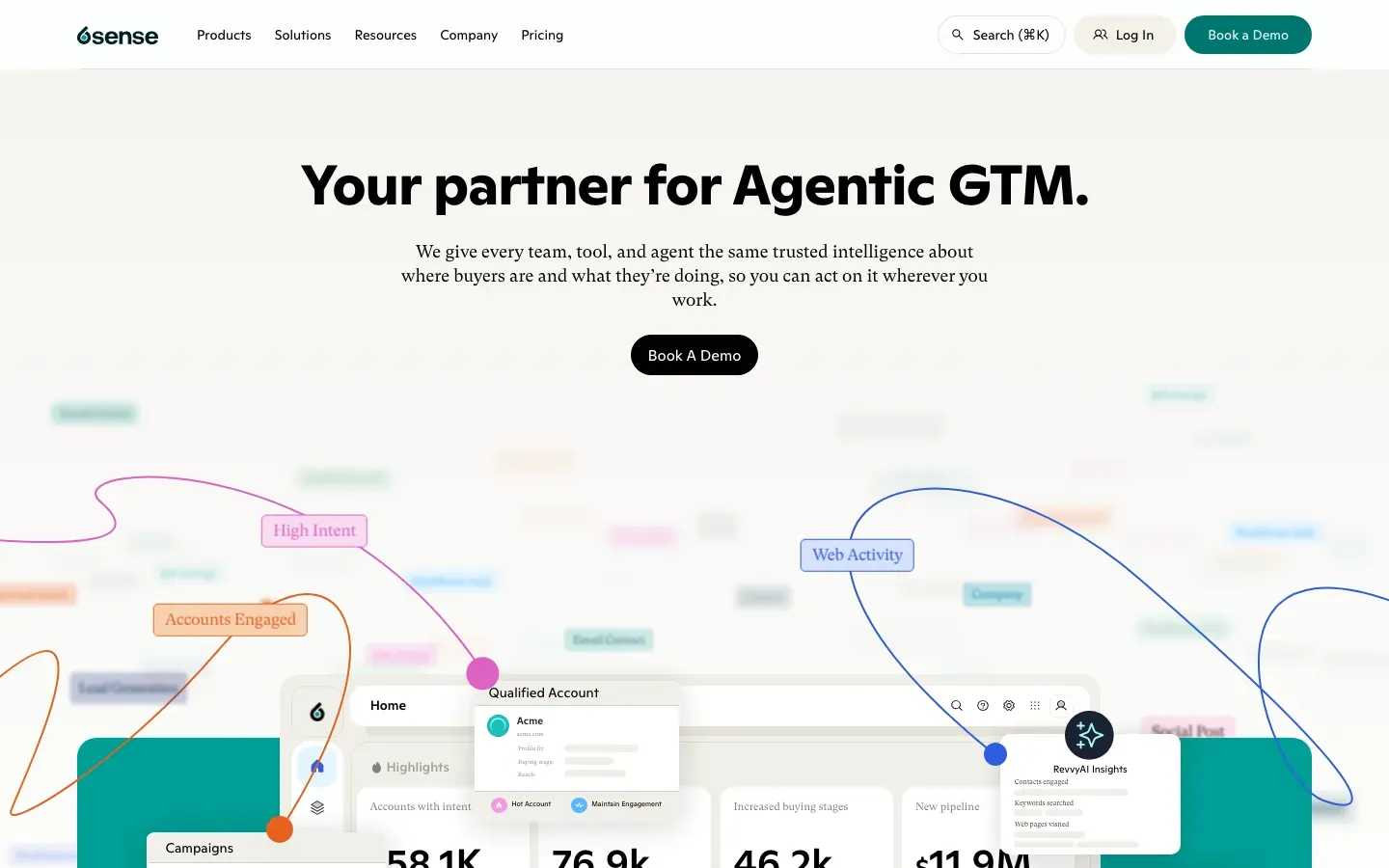
Where it beats AdRoll ABM: it starts from the account and the buyer’s stage, not only from a list you bring, and it serves sellers as well as marketers. Its advertising builds audiences from buying stage intent, syncs them to Google, LinkedIn and Meta, and runs its own demand side platform. If sales and marketing must work from the same intent signals, 6sense is the closer fit.
Where it falls short for a small team: 6sense is a wide platform, and most of its cost sits outside the ads you run. If you need to launch or fix a campaign this week, you will touch only a small part of it.
6sense shows no price on its pricing page (opens in new tab). The page talks about flexible pricing based on your go to market journey, offers a quote and leads to a demo. There is no free tier listed. For a side by side, see 6sense compared with Hero Marketer.
4. Demandbase: best for account based go to market teams
Demandbase (opens in new tab) describes itself as an ABM platform for B2B sales and marketing. It finds in market accounts, ranks their buying groups and advertises to those accounts across channels.
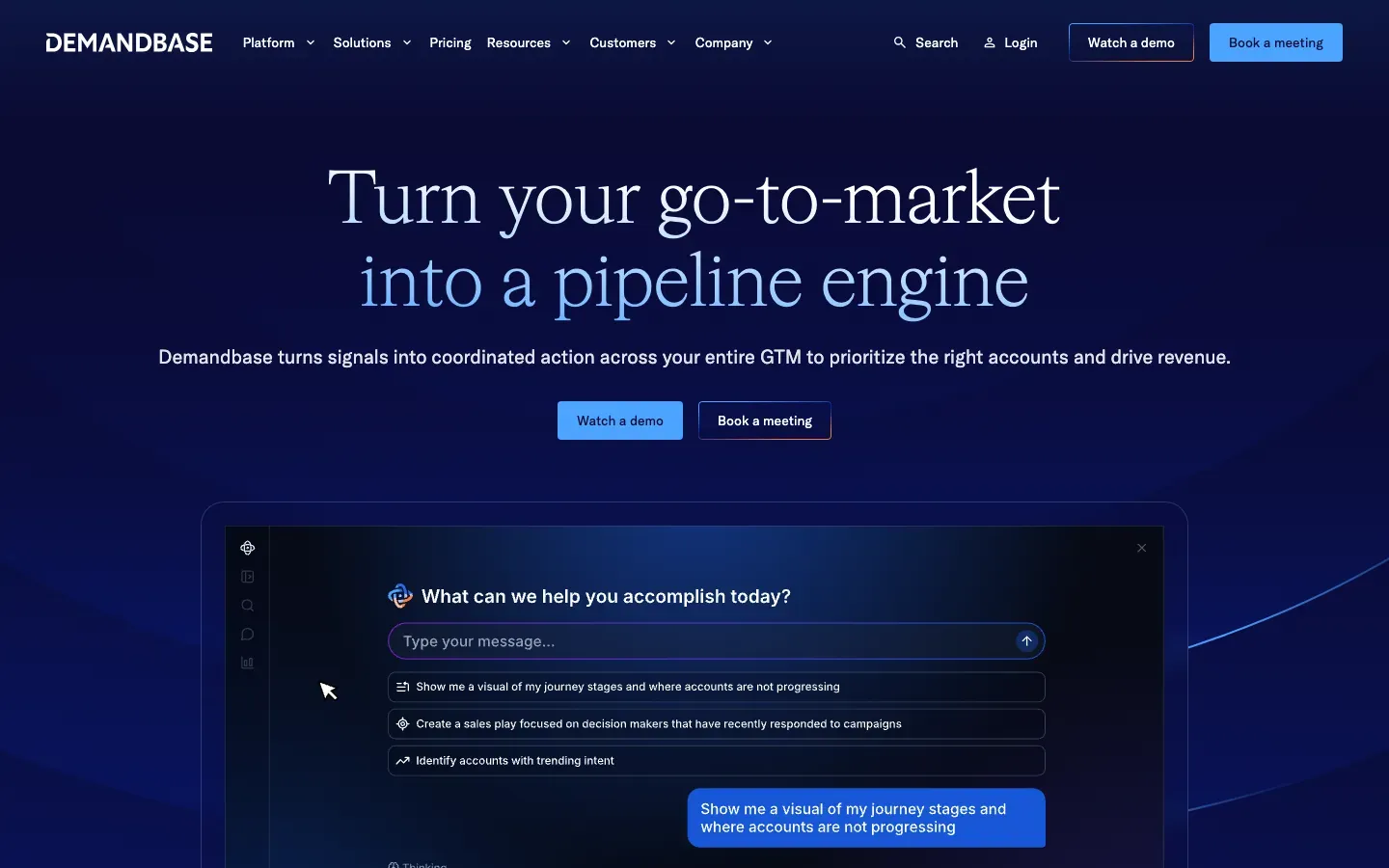
Where it beats AdRoll ABM: it ties advertising to account lists and to the sales team’s work on the same accounts. If your program runs on named accounts and sellers act on the same signals, that is its home ground.
Where it falls short for a small team: Demandbase expects a go to market team that keeps account lists, works with sales and has someone to run the platform. A single marketer running search and social in their own ad accounts would leave most of it unused.
Its pricing page (opens in new tab) shows no prices. You fill out a form, and Demandbase builds a custom plan. For a side by side, see Demandbase compared with Hero Marketer.
5. HockeyStack: best for attribution across many channels
HockeyStack (opens in new tab) sells GTM analytics and attribution. It connects to Salesforce, HubSpot and Microsoft Dynamics.
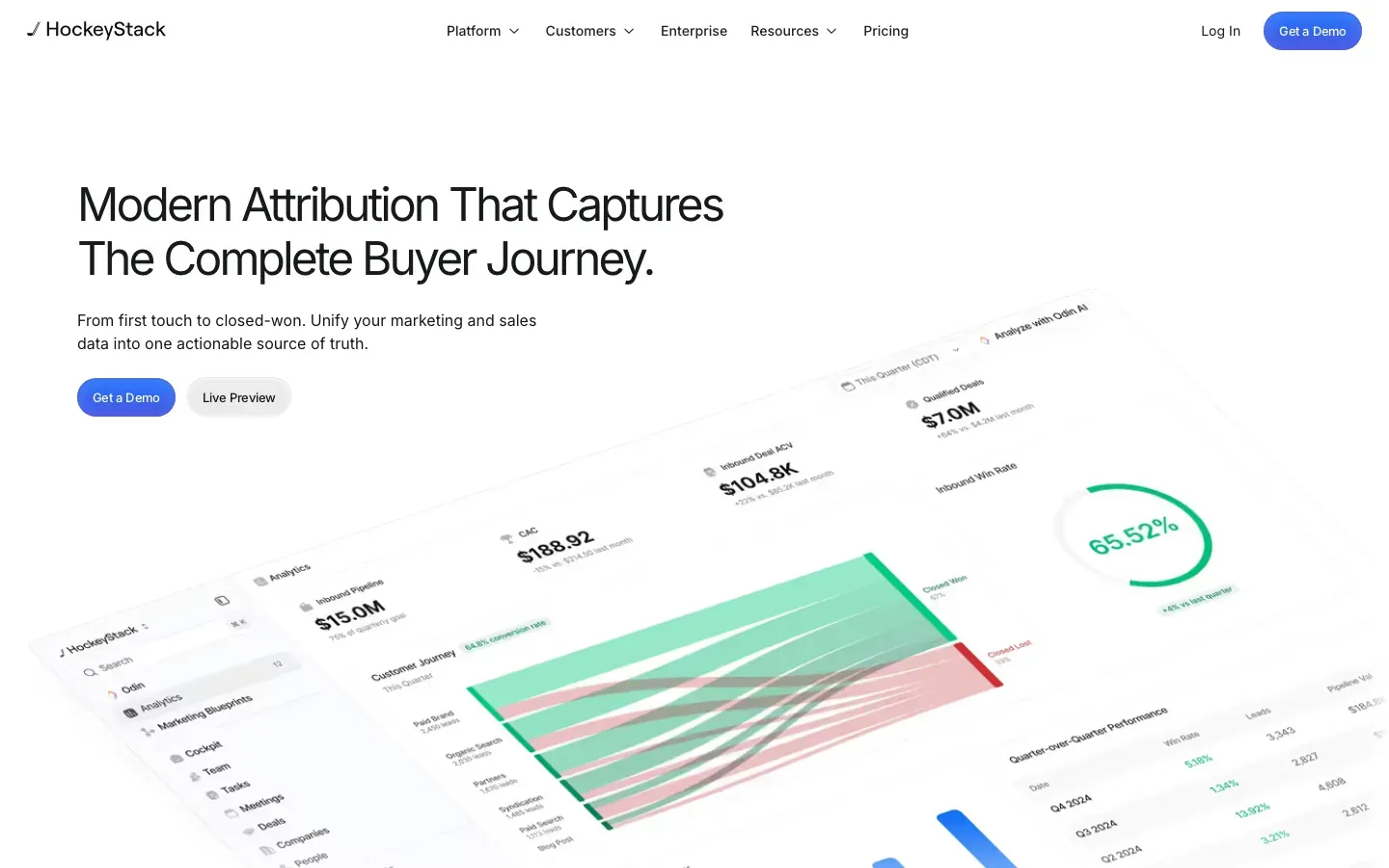
Where it beats AdRoll ABM: it answers a different question. If you need to show which of three to six channels earns credit for pipeline, a tool built around attribution will go deeper than the reporting in an ads platform.
Where it falls short for a small team: in its own guide to who it fits (opens in new tab), HockeyStack names B2B SaaS companies with 100 or more employees as its primary customer. A company of 30 to 100 people is a secondary fit, and it advises against fewer than 30. It measures ads and does not build or run them.
Its pricing page (opens in new tab) offers custom plans on a demo, and says startup pricing is available. Because it measures and the other tools on this list run or buy the ads, it can sit beside any of them. See HockeyStack compared with Hero Marketer.
6. Dreamdata: best for B2B attribution that starts on a free plan
Dreamdata (opens in new tab) describes itself as an agentic B2B attribution platform. It tracks the customer journey so you can see what marketing adds to pipeline.
Where it beats AdRoll ABM: you can start for free. Its pricing page shows a free plan with no card needed, limited to two months of user history, five seats and one sync. That is a real way to find out what your channels bring before you pay for more media.
Where it falls short for a small team: Dreamdata measures, and nothing on its pages covers building or running campaigns. The ads still have to be built and fixed somewhere else.
Beyond the free plan, its pricing page (opens in new tab) puts the Advanced plan on a demo, with activation and a data warehouse as add ons. Like HockeyStack, it works beside a tool that helps you run the ads. For a side by side, see Dreamdata compared with Hero Marketer.
How to choose
Start from the job, then check the team.
- You run Google, LinkedIn and Meta ads yourself and own the number. Hero Marketer. An AI agent for B2B SaaS ads management fits the person who decides and wants help with the work. It does not fit anyone who wants a service to do it for them.
- You want a vendor to build and run many channels, and the budget fits a scoped contract. Metadata.io.
- Your sales team and marketing team need the same intent data. 6sense or Demandbase. Plan for a demo and a custom package.
- Your question is which channel brings pipeline. HockeyStack if you are about 100 people or more with a CRM it supports. Dreamdata if you want to start on a free plan.
- You need both measurement and ad running. Pair an attribution tool with an agent that helps you run the ads. They do different jobs.
When to stay on AdRoll ABM
Stay if display, native, video or connected TV aimed at a list of accounts is the job, and its media pricing fits your plan. Stay if the Account Based Retargeting package already brings the accounts you want back to your site. Hero Marketer does not buy that media, so the two can run side by side. The switch is only worth it if what you need now is search, LinkedIn and Meta campaigns that someone builds and fixes. Before you change how an account runs, read your AdRoll agreement.
FAQ
What are the best AdRoll ABM alternatives?
It depends on the job. For a lean B2B SaaS team that runs its own Google, LinkedIn and Meta ads, Hero Marketer. For a vendor that runs paid media across many channels, Metadata.io. For intent data and sales led ABM, 6sense or Demandbase. For attribution, HockeyStack or Dreamdata.
What does AdRoll ABM cost?
AdRoll’s pricing page shows no dollar figures. Its Ads plan is self serve and pay as you go, with no minimum spend, and media is priced per thousand impressions, so cost moves with demand. Most ABM packages start with a demo request. Ask for a quote on any ABM package, and ask about contract length. Hero Marketer is pay as you go, and its rates are on its pricing page.
Is RollWorks now AdRoll ABM?
Yes. The old rollworks.com address now sends visitors to AdRoll’s account based marketing page (opens in new tab), where the product is called AdRoll ABM. AdRoll offers it to B2B revenue and marketing teams that want to reach target accounts.
AdRoll ABM vs 6sense: which fits?
They do different jobs. AdRoll ABM buys programmatic media and retargets the accounts you target. 6sense starts from intent data on accounts and serves sales and marketing together. Pick AdRoll ABM if the job is buying reach for a list you already have. Pick 6sense if the job is knowing which accounts are in market.
Does AdRoll ABM fit a small team?
It can. Its Ads plan has no minimum spend and you sign up on your own. But it buys display, native, video and connected TV reach. It does not build or fix Google search, LinkedIn or Meta campaigns, so the weekly work of a lean team stays with you. A founder or first marketer who runs those three platforms will find Hero Marketer a closer fit.